Product quality
Garcia is a fashion brand dedicated to dressing families with high-quality clothing. We carefully select our business partners and maintain ongoing communication to improve garment quality and ensure legal compliance. Our supplier manual outlines our quality standards. In addition, we test materials and garments for fabric properties and chemical regulations. We regularly perform quality checks on incoming items and address any issues with our business partners. At our headquarters, we conduct washing, shrinkage, and color fastness tests on new fabrics and incoming items, discussing any problems with our partners to ensure top quality.
Restricted Substances List (RSL)
We ensure the safety of our clothing for both people and the environment by managing the chemicals used in production. To address this, we adopted a Restricted Substances List (RSL) in 2016, which sets limits on harmful chemicals in our products. Our business partners must comply with these standards. We update our RSL annually to meet European regulations, including REACH. Our latest RSL (version 7.0 published in 2024) exceeds legal requirements, reflecting our commitment to higher safety standards. Our CSR and product development teams use a risk assessment approach to select and test parts of our collection for RSL compliance. Independent testing agencies examine the selected products before shipping to Rotterdam. If a product fails, the business partner must submit a Corrective Action Plan (CAP) within 48 hours. We also conduct random tests on bulk shipments upon arrival at our warehouse.

Materials
Responsible Sourcing of Materials
Garcia is committed to ensuring that the raw materials in its products are sourced responsibly, avoiding origins and practices that violate our JOG Group Animal Welfare & Preferred Sustainable Materials principles. We also avoid materials from regions with serious human rights violations or those that negatively impact the environment or worker health. We expect our business partners to respect and implement these sourcing decisions throughout their supply chains. All our business partners must adhere to the following material restrictions for Garcia products:
- No use of cotton grown in Turkmenistan, Syria, or Xinjiang (China).
- No use of fur, down, merino from mulesed sheep, or angora fibers (angora rabbit hair).
- No use of exotic animal skins (e.g., snake, alligator, crocodile, lizard, and ostrich).
- No use of animal materials derived from species threatened or endangered.
- No use of plant-based materials derived from species threatened or endangered.
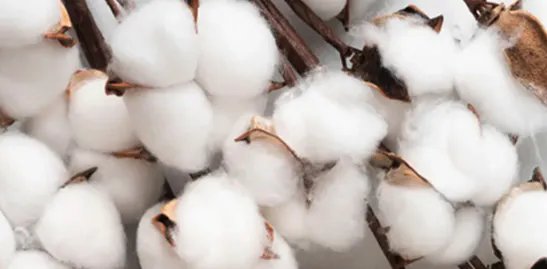
Our Take on Cotton
Our preferred choice for cotton is Better Cotton, and we make strong efforts to reduce the use of conventional cotton. However, given the continuous development of the fashion industry and materials, we recognize the need to adapt our brand strategy. In alignment with this, we are actively increasing the proportion of recycled cotton, including both post-consumer recycled and pre-consumer recycled cotton.

Our Take on Synthetics
Currently, our focus is on reducing the use of virgin synthetic materials like polyester and polyamide. Mechanically recycled polyester is considered the "best option" in the MFM, but its availability remains limited. Therefore, we aim to minimize polyester use and substitute synthetic materials with man-made cellulosic alternatives whenever possible. When polyester is necessary, we prioritize recycled polyester.

Material matrix
Modint, the Textile Branch Association, has developed the Modint Fibre Matrix (MFM), a practical tool guiding designers, buyers, and decision-makers in making sustainable material choices. The MFM rates fibers based on a circular model. Our material selection process begins with our Design Teams, who explore suitable alternatives. We have set internal material goals for the next five years to drive significant progress in our sustainable sourcing journey. At Garcia, we focus on making the "better choice" whenever possible and are actively working to phase out conventional materials.
Many of the products available in our stores now feature “better or best” materials, showing our commitment to responsible choices. These materials and processes include recycled materials, Lenzing Ecovero, Tencel Modal, Better Cotton and/or are treated with a less impact wash treatment.
Our Take on Recycled materials
The use of GRS-certified recycled cotton and polyester is a powerful step toward a circular future. By choosing these materials, we give waste a new life, reduce the demand for virgin resources, and lower the environmental footprint of our products. GRS (Global Recycled Standard) ensures that the recycled material meets strict environmental standards and ethical production processes, allowing us to contribute not only to a circular economy but also to improved working conditions. Together, we make conscious choices that benefit both the planet and people. As from 2024, our business partners are GRS/RCS-certified.
Learn more at Recycled Claim Standard (RCS) + Global Recycled Standard (GRS) - Textile Exchange.

Animal Welfare
Our Code of Conduct includes a dedicated “Animal Welfare & Preferred Sustainable Materials” appendix. All Garcia products must be made without harm or cruelty to animals at any stage of production. We believe in treating animals with care, respect, and dignity, adhering to the five freedoms set by the Farm Animal Welfare Committee (FAWC).
These five freedoms are:
1 Freedom from hunger and thirst.
2 Freedom from discomfort.
3 Freedom from pain, injury, and illness.
4 Freedom from fear and distress.
5 Freedom to express normal behavior.

Jeanologia
Jeanologia® provides innovative technology to measure and improve the environmental impact of denim production. Most of our manufacturers work with this technology, and all partners track their impact using the EIM software (Environmental Impact Measuring). his software gives insights into water, energy, and chemical usage, as well as worker health, with lower scores indicating a more sustainable process. Based on these scores, we set targets and continuously engage with our manufacturers to further reduce our impact.

Bleaching/Lightening techniques
Ozone is a technique that replaces stone washing but still gives our denim an authentic, used look. Ozone gas (O₃) is a powerful oxidizing agent that breaks down indigo dye on denim, creating a faded or vintage look without using harsh chemicals like chlorine or potassium permanganate.

E-flow techniques
Conventional processes use water to apply chemicals to textiles. Each cycle produces wastewater that requires treatment. Jeanologia®'s E-Flow technology uses nanobubbles of air as a carrier for chemicals. This allows the same effect to be achieved with significantly less water and without the release of wastewater during the process, according to the manufacturer s technical specifications.

Laser treatment instead of traditional washings
Laser treatment is an innovative method which gives our denims a faded vintage or distressed look with very little environmental impact. This treatment is done with a laser that goes over our jeans and burns in them, saving not only water but energy and worker impact too.
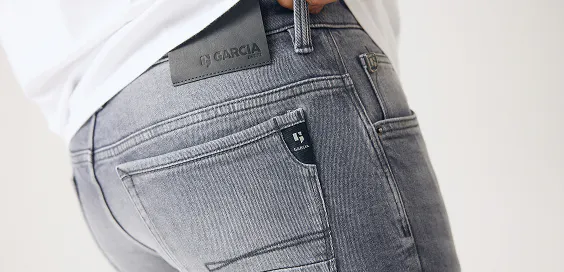
Denim back labels
Jeans traditionally have leather labels, but the leather industry has a significant impact on deforestation, animal welfare and water pollution. At GARCIA, we decided to replace leather for Jacron. Our jacron label looks like leather but has less impact on the environment as it is largely a
paper-based material sourced from certified, sustainably managed forests.

Clevercare washing tips
Clevercare wash tips are guidelines provided by the Clevercare initiative to help you reduce the environmental impact of washing your clothes. These tips aim to promote sustainable practices in laundry care and contribute to reducing the environmental footprint associated with clothing maintenance. Here are some common Clevercare wash tips:
- Lower Temperature: Wash clothes at lower temperatures whenever possible to save energy and reduce carbon emissions.
- Avoid Over-washing: Wash clothes only when necessary to prolong their lifespan and reduce water usage.
- Use Full Loads: Wash full loads to maximize efficiency and save water and energy.
- Line Dry: Air dry clothes when feasible instead of using a dryer to save energy.
- Iron Less: Iron clothes only when necessary to save energy.
- Use Eco-Friendly Detergents: Choose detergents that are biodegradable and environmentally friendly.
- Follow Care Labels: Follow the care instructions on clothing labels to maintain their quality and durability.
Find out more at clevercare.inf.
Meer inspiratie


Keep in touch
Schrijf je nu in voor onze nieuwsbrief en ontvang €10 korting!
betaalmogelijkheden